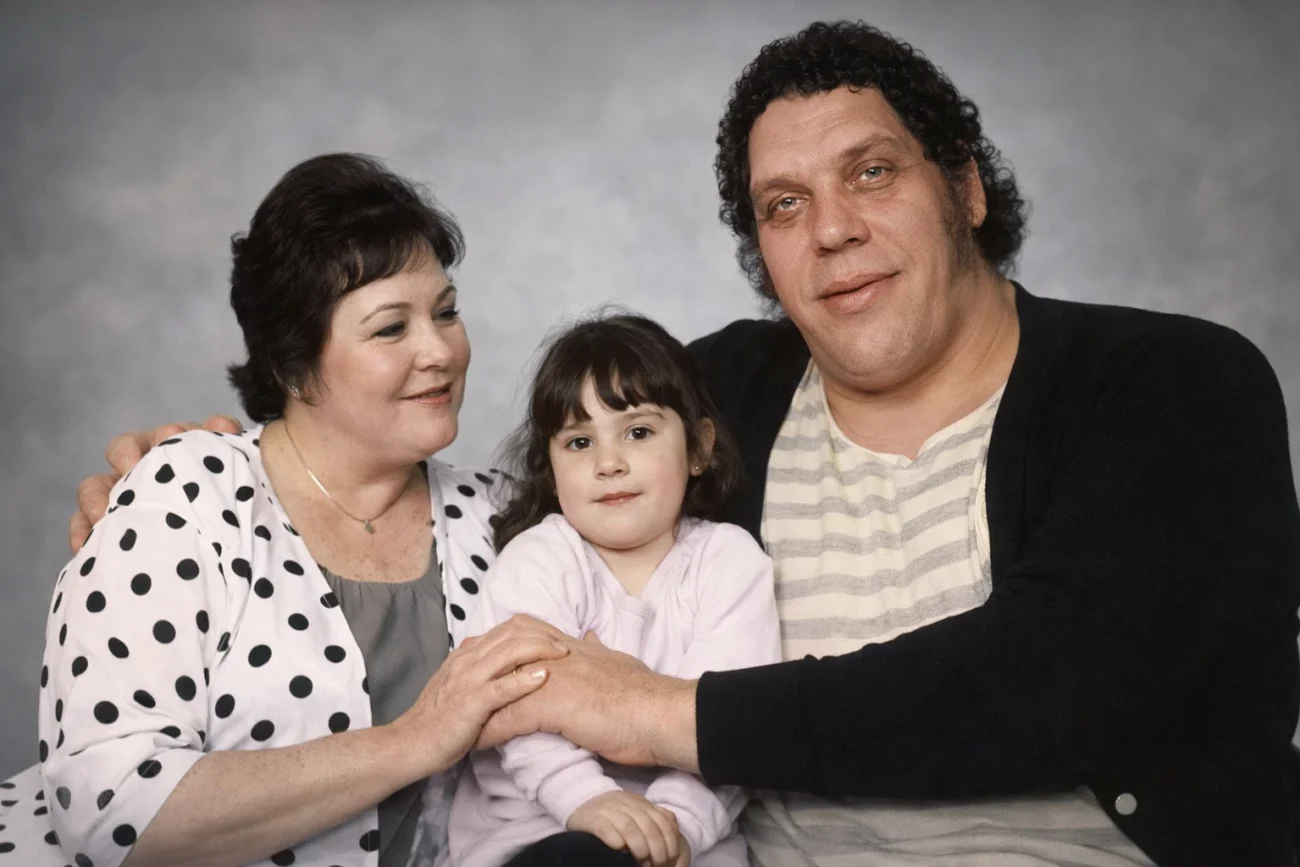
Unlike many figures tied to cultural icons, Jean Christensen did not cultivate a public persona. Her story must be pieced together through scattered records, interviews with her daughter, and fragments of wrestling history. That scarcity makes her biography both challenging and revealing. It forces a focus on what can be verified and invites a more careful look at the human realities behind one of entertainment’s most exaggerated figures.
Early Life and Background
Jean Christensen’s early life remains largely undocumented in reliable public sources, a fact that shapes how her story must be told. Unlike André Roussimoff, whose physical condition and wrestling career drew international attention, Christensen lived outside the spotlight for most of her life. Details about her childhood, family background, and education are not publicly confirmed, and attempts to reconstruct them often rely on weak or repetitive sources.
What can be said is that she entered adulthood at a time when professional wrestling was undergoing significant change. The industry in the 1970s was expanding across territories, building its audience through television, and creating larger-than-life personalities who could draw crowds across regions. This environment would eventually become the setting where Christensen’s life intersected with André’s.
The absence of early-life documentation is not unusual for individuals who worked behind the scenes in entertainment during that period. Many roles, especially those tied to publicity and administration, left little trace in the public record. Christensen’s later association with wrestling suggests she was part of that infrastructure, even if her contributions were not widely recorded.
Entry Into the Wrestling World
Jean Christensen’s connection to professional wrestling appears to have come through work rather than chance. Several accounts describe her as being involved in public relations within the wrestling industry, a role that would have placed her in direct contact with talent, promoters, and media outlets. Public relations in wrestling during the 1970s required a mix of logistical skill and discretion, as the industry relied heavily on maintaining its image while managing the realities behind the scenes.
This role would have made Christensen part of the machinery that supported touring wrestlers like André the Giant. Wrestlers of André’s stature traveled constantly, appearing in different cities and promotions, often under intense physical strain. The people who handled communication, scheduling, and press relations were essential to sustaining that pace.
It was within this professional context that Christensen is believed to have met André Roussimoff in the early 1970s. Their connection did not emerge from the typical celebrity pathways of publicity or spectacle. Instead, it appears to have developed within the working environment of wrestling, where personal and professional boundaries often overlapped.
Relationship With André the Giant
André Roussimoff, known worldwide as André the Giant, was already becoming a phenomenon when he met Jean Christensen. Born in France in 1946 and affected by acromegaly, a condition that caused his extraordinary size, André was marketed as “The Eighth Wonder of the World.” His wrestling career took him across continents, and his persona was carefully constructed to emphasize both his physical presence and his mystique.
Christensen’s relationship with André existed in tension with that public image. While André was portrayed as a solitary giant, larger than life and difficult to categorize, his connection with Christensen reveals a more ordinary, human dimension. Their relationship, however, was not extensively documented at the time, and much of what is known comes from later accounts.
One of the most persistent points of confusion concerns whether Christensen and André were married. Some modern sources describe her as his wife, while others refer to her as his partner. Reliable historical accounts do not conclusively confirm a legal marriage, and the inconsistency across sources suggests that the exact nature of their relationship remains uncertain.
What is clear is that their connection resulted in the birth of their daughter, Robin Christensen-Roussimoff. This fact anchors Christensen’s place in André’s story and provides the most direct link to her life.
Motherhood and Raising Robin
Robin Christensen-Roussimoff was born in 1979 in France, during a period when André’s career required constant travel. Shortly after her birth, Robin’s life became centered in the United States, where she was primarily raised by her mother. This arrangement would shape both Robin’s childhood and the public understanding of Jean Christensen’s role.
Robin has spoken openly about her upbringing, offering one of the few firsthand perspectives on her mother. She described a childhood in which her father was largely absent, not out of indifference but because of the demands of his career and the complexities of his life. According to Robin, she met André in person only a handful of times, a detail that underscores the distance between his public presence and his private responsibilities.
In that context, Christensen emerges as the primary parent. She provided stability and continuity, raising Robin away from the constant attention that surrounded André. One telling detail from Robin’s recollections is that her mother did not encourage her to watch André’s wrestling matches at home. This decision suggests an effort to separate the image of the performer from the reality of the man, allowing Robin to form her own understanding rather than inheriting a public narrative.
Motherhood, in Christensen’s case, was not simply a personal role but a defining part of her legacy. It required navigating legal, emotional, and logistical challenges, many of which remain only partially documented. Yet the consistency of Robin’s account points to a parent who prioritized her child’s well-being over the allure of fame.
Legal Disputes and Family Strain
The relationship between Jean Christensen and André the Giant was not without conflict. Reports connected to Robin’s upbringing indicate that there were legal disputes related to paternity and child support. These disputes, while not extensively detailed in public records, suggest a complicated dynamic that extended beyond their personal relationship.
Robin has mentioned that some of her encounters with her father occurred in court settings, a striking detail that reflects the formal and sometimes adversarial nature of their interactions. This aspect of the story contrasts sharply with André’s public image as a gentle giant and beloved entertainer.
Such tensions were not uncommon in the lives of performers who spent long periods on the road. Wrestling, in particular, demanded a schedule that made sustained family life difficult. For Christensen, these circumstances meant balancing the responsibilities of raising a child with the challenges of maintaining a connection to a partner whose life was defined by movement and performance.
The legal and emotional strain associated with these disputes adds depth to Christensen’s story. It highlights the realities that often remain hidden behind celebrity narratives, where personal relationships are shaped by factors that are rarely visible to the public.
Life Outside the Spotlight
Despite her connection to a global icon, Jean Christensen maintained a largely private life. She did not seek media attention, and there is little evidence that she attempted to capitalize on her association with André. This choice distinguishes her from many individuals linked to celebrity figures, whose lives often become entangled with publicity.
Her work in wrestling public relations, while not extensively documented, suggests a professional identity that existed independently of her personal relationship. It also indicates a level of familiarity with the industry that likely informed her approach to privacy. Understanding how narratives are constructed may have influenced her decision to remain outside them.
Christensen’s private life also reflects a broader pattern among those who work behind the scenes in entertainment. Their contributions are essential, yet their stories are often overlooked. In Christensen’s case, this invisibility has contributed to the scarcity of reliable information about her life.
What remains is a portrait defined by restraint. Rather than leaving behind a trail of interviews or public appearances, she is remembered through the impact she had on those closest to her, particularly her daughter.
Later Years and Death
Jean Christensen is reported to have died in 2008, though detailed public records of her later years are limited. As with much of her life, the absence of extensive documentation makes it difficult to reconstruct her final years with precision. There are no widely cited interviews, memoirs, or public statements that offer insight into her perspective during that period.
Her death did not generate significant media coverage, which is consistent with the private nature of her life. It also reflects the way her story has been framed in relation to André’s legacy, rather than as a standalone narrative. For many readers, her name becomes relevant only when exploring André’s biography or Robin’s life.
This lack of visibility does not diminish her significance. Instead, it reinforces the idea that her life unfolded largely outside the structures that typically preserve public memory. Her legacy is therefore carried through indirect means, particularly through her daughter’s recollections.
Public Image and Cultural Context
Jean Christensen’s public image is shaped less by her own actions than by the narratives surrounding André the Giant. In wrestling history, André occupies a unique position as both a performer and a mythic figure. This dual identity often leaves little room for the people connected to him, whose lives are overshadowed by his larger-than-life persona.
Christensen’s story challenges that imbalance. It introduces a human dimension that complicates the myth. Through her role as a mother and her connection to the wrestling industry, she represents the everyday realities that exist alongside extraordinary fame.
Her story also highlights the limitations of celebrity-focused history. When attention is concentrated on a single figure, the contributions and experiences of others can be reduced or ignored. Christensen’s life invites a broader perspective, one that acknowledges the network of relationships that shape even the most iconic careers.
Legacy Through Robin Christensen-Roussimoff
If Jean Christensen’s life has a clear legacy, it is found in her daughter. Robin Christensen-Roussimoff has, over time, become a public figure in her own right, particularly within wrestling circles. She has participated in events, spoken about her father, and engaged with fans who are curious about André’s personal life.
Robin’s perspective provides a rare and valuable link to both her parents. Through her accounts, Christensen’s influence becomes visible. The stability, values, and perspective that Robin expresses are, in many ways, reflections of the environment her mother created.
This legacy is not defined by public recognition or financial success. Instead, it is rooted in the quieter, more enduring aspects of family life. It speaks to the impact of parenting, especially in circumstances shaped by distance and complexity.
Frequently Asked Questions
Who is Jean Christensen?
Jean Christensen is best known as the mother of Robin Christensen-Roussimoff and as the partner of professional wrestler André the Giant. She was reportedly involved in public relations within the wrestling industry and lived much of her life outside the public spotlight.
Was Jean Christensen married to André the Giant?
The exact nature of their relationship is not clearly confirmed. Some sources describe her as his wife, while others refer to her as his partner. Reliable records do not conclusively establish that they were legally married.
What did Jean Christensen do for a living?
She is believed to have worked in public relations within the wrestling business. This role likely brought her into contact with André the Giant and other figures in the industry.
Did Jean Christensen have children?
Yes, she had one daughter, Robin Christensen-Roussimoff, who is widely recognized as André the Giant’s only child.
When did Jean Christensen die?
Jean Christensen is reported to have died in 2008. Detailed public information about her death is limited.
Why is Jean Christensen still talked about?
She remains of interest because of her connection to André the Giant and her role in raising their daughter. Her story offers insight into the private side of a widely known public figure.
Conclusion
Jean Christensen’s life does not fit neatly into the categories that often define celebrity biographies. There are no widely celebrated achievements, no carefully curated public persona, and no extensive archive of interviews or appearances. What exists instead is a quieter story, one that unfolds through relationships, responsibilities, and the choices made away from public view.
Her connection to André the Giant ensures that her name will continue to surface, but it is her role as a mother and as a participant in the wrestling world that gives her story its substance. These aspects reveal a life shaped not by spectacle, but by the everyday demands of work and family.
The limited nature of the public record can be frustrating, but it also serves as a reminder of how many lives remain partially hidden, even when they intersect with fame. In Christensen’s case, that partial visibility invites a more thoughtful approach, one that respects both what is known and what remains uncertain.
Her legacy, carried forward through her daughter and through the broader history of wrestling, is defined by presence rather than publicity. It is a legacy that may never be fully documented, but it continues to resonate in the spaces where public myth meets private reality.
