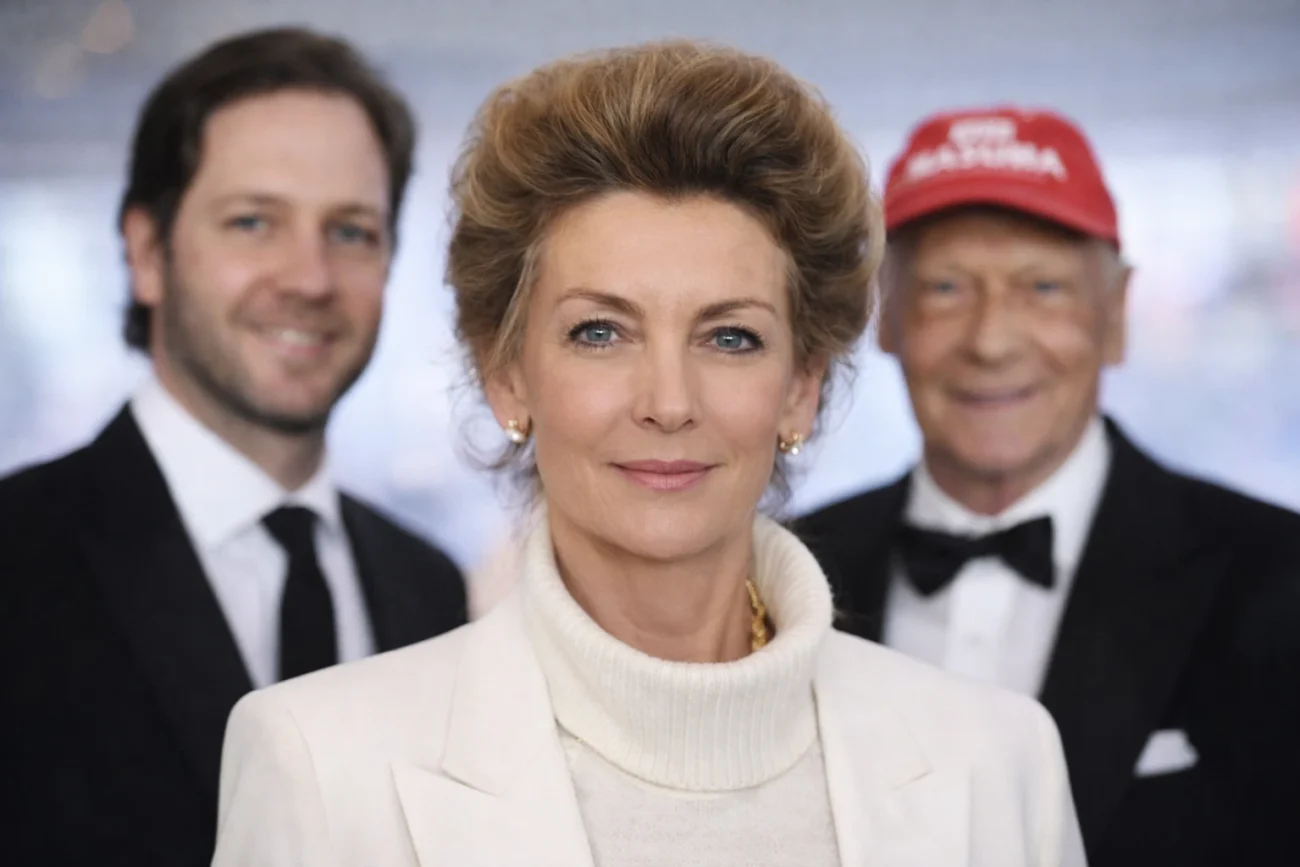
Her story, such as it can be told with confidence, is not one of constant visibility. It is instead a story of presence, distance, and the limits of what public life reveals. Marlene Knaus remains tied to one of motorsport’s defining eras, yet she has managed to remain largely absent from the modern machinery of fame. That contrast is what continues to draw people to her name.
Early Life and Background
The early life of Marlene Knaus is one of the least documented aspects of her biography, and that absence of detail shapes how she is understood today. Most widely circulated profiles describe her as having been born in 1956, often in Venezuela, to a family with European roots. But here’s the truth: those details are not strongly confirmed by primary sources, and much of what is repeated online traces back to secondary or tertiary accounts rather than direct documentation.
What can be said with more confidence is that she emerged into public awareness in Europe, particularly within social and fashion circles. By the early 1970s, she was already recognized as a stylish and visible figure, which suggests she had built some level of presence before her association with Niki Lauda. Photographs from that period show her with a polished, distinctive look that fit the aesthetic of the time, reinforcing the idea that she moved comfortably within fashion-oriented environments.
Not many people know this, but the way Knaus appeared in early photographs helped define how she would later be remembered. She was not portrayed as a background figure who simply followed a famous partner. Instead, she carried herself with a quiet confidence that photographers and journalists picked up on, even if they did not fully document her story.
Entry Into Public Life and Modeling Career
Marlene Knaus is often described as a model, and while detailed records of her modeling work are limited, the description aligns with the available visual evidence. She appeared regularly in social settings associated with fashion and high-profile European lifestyles, and her image was widely circulated in magazines and event photography of the time. That visibility alone suggests she had a recognized presence, even if the specifics of her professional work remain less clearly documented.
The modeling world of the 1970s operated very differently from today’s industry. It was less centralized, less digitally archived, and far more dependent on in-person networks and print exposure. As a result, many figures who were well-known in their moment left behind relatively sparse official records compared to modern standards. Knaus seems to fall into that category, where her influence was real but not extensively cataloged.
What’s surprising is how quickly her identity became tied to her relationship with Lauda, even though she appears to have had her own independent social standing. Once she entered the orbit of Formula 1, the narrative shifted. She was no longer just a figure in fashion circles; she became part of a much larger story that would overshadow most of her earlier life.
Relationship With Niki Lauda
Marlene Knaus met Niki Lauda in the early 1970s, a time when he was building his reputation as one of Formula 1’s most disciplined and analytical drivers. Their relationship developed during a period of intense professional growth for Lauda, and by the mid-1970s, they had become one of the most recognizable couples in the sport. They married in 1976, the same year Lauda won his second Formula 1 World Championship.
That year also brought one of the most dramatic moments in motorsport history. Lauda’s near-fatal crash at the Nürburgring in August 1976 left him with severe burns and lung damage. He returned to racing just weeks later, an act that became central to his legacy. For Knaus, this was not just a public spectacle but a deeply personal crisis, one that unfolded under intense global attention.
The truth is, much of what she experienced during that time remains undocumented in her own words. There are no widely known interviews in which she describes those events in detail. Yet her presence during that period is evident, and it adds a layer of human context to a story that is often told in terms of courage and competition alone.
Life as a Formula 1 Partner in the 1970s
To understand Marlene Knaus’s place in history, it helps to consider what it meant to be closely connected to a Formula 1 driver during the 1970s. The sport was entering a new phase of commercial growth and media attention, but safety standards were still evolving. Drivers faced significant risks, and the people closest to them lived with that reality in a way that was rarely discussed publicly.
Knaus became a familiar figure in the paddock, appearing at races and events alongside Lauda. Photographs from the era show her in conversations, celebrations, and quieter moments, often positioned just outside the center of attention. She was visible, but not performative, which contributed to her lasting impression.
Here’s where it gets interesting. While many partners of athletes later sought public roles or media careers, Knaus did not follow that path. Even during her most visible years, she maintained a certain distance from the machinery of publicity. That restraint would later define how her story unfolded.
Marriage, Family, and Children
Marlene Knaus and Niki Lauda had two sons together, Lukas Lauda and Mathias Lauda. Their family life, like much of Knaus’s personal history, was kept largely private. What is publicly known comes mainly through the later careers of their children, particularly Mathias.
Mathias Lauda followed in his father’s footsteps and became a professional racing driver. He competed in various racing series and achieved success in endurance racing, including winning the FIA World Endurance Championship in the LMGTE Am category in 2017. Lukas, meanwhile, has been involved in the business and management side of racing, including working with his brother.
What stands out is that Knaus remained connected to a family that continued to operate in the public eye, even as she herself stepped back. Her role as a mother is one of the few aspects of her life that carries forward into the present in a visible way, though still indirectly.
Divorce and Life After Niki Lauda
After 15 years of marriage, Marlene Knaus and Niki Lauda divorced in 1991. The reasons behind their separation have not been widely documented in reliable sources, and many of the explanations that circulate online rely on speculation rather than confirmed reporting. What can be stated with certainty is the timeline and the fact of the divorce itself.
Following the end of the marriage, Knaus retreated further from public life. Unlike many individuals connected to high-profile figures, she did not pursue media interviews, memoirs, or public commentary about her experiences. That decision has shaped how she is perceived, leaving more questions than answers.
The truth is, her withdrawal coincided with a period when celebrity culture was becoming more intrusive and more permanent. By stepping away when she did, she avoided becoming part of the constant cycle of exposure that defines modern fame. It was a choice that seems deliberate, even if it was never publicly explained.
Public Image and Media Portrayal
Marlene Knaus’s image has been shaped largely by photographs, brief mentions in articles, and her portrayal in popular culture. One of the most notable representations came in the 2013 film Rush, which dramatized the rivalry between Niki Lauda and James Hunt. In the film, Knaus was portrayed by Alexandra Maria Lara, bringing her character to a new audience.
That portrayal emphasized her role as a supportive and composed partner, but like most dramatizations, it simplified a complex reality. Films often require clear narratives, and real lives rarely fit neatly into those structures. The version of Knaus presented in Rush is part of her story, but it is not the whole story.
But here’s the thing. When a person does not actively shape their own public narrative, others inevitably do it for them. In Knaus’s case, that has led to a mix of accurate detail and creative interpretation, making it harder to separate fact from embellishment.
Business Interests and Net Worth
There is very little verifiable information about Marlene Knaus’s financial status or business activities. Many online sources assign her a specific net worth, often without clear evidence or sourcing. In the absence of reliable financial disclosures or confirmed reporting, those figures should be treated with caution.
It is reasonable to assume that her life during and after her marriage to Niki Lauda provided financial stability, especially given Lauda’s successful career in racing and later in aviation and business. However, assumptions about her personal wealth should not be presented as confirmed fact.
What’s clear is that Knaus has not used her public association to build a visible business empire or personal brand. That choice aligns with the broader pattern of her life, where privacy has taken precedence over public opportunity.
Where Marlene Knaus Is Now
As of 2026, Marlene Knaus continues to live a private life, and there is no widely confirmed public record of her current residence or daily activities. Some reports suggest she has spent time in Ibiza, Spain, but recent, independently verified information is limited.
Her absence from public platforms is striking in an era when even minor public figures maintain a digital presence. She does not appear to engage with social media, interviews, or public events, which reinforces the sense that her withdrawal from visibility is intentional and sustained.
The truth is, her current life is defined more by what is not known than by what is. And in a culture that often expects constant updates, that absence has become part of her identity.
Frequently Asked Questions
Who is Marlene Knaus?
Marlene Knaus is best known as the first wife of Formula 1 champion Niki Lauda. She gained public attention during the 1970s when Lauda was at the peak of his racing career. Beyond that, she is widely described as a former model, though detailed records of her career are limited.
Was Marlene Knaus a model?
She is commonly described as a model, and her presence in fashion and social circles during the 1970s supports that description. However, there is limited publicly available documentation of specific modeling work. Much of the information comes from secondary sources rather than primary records.
How many children does Marlene Knaus have?
Marlene Knaus has two sons with Niki Lauda: Lukas Lauda and Mathias Lauda. Mathias became a professional racing driver, while Lukas has been involved in business and management roles within the motorsport world.
Why did Marlene Knaus and Niki Lauda divorce?
The couple divorced in 1991, but the exact reasons for their separation are not well documented in reliable public sources. Many explanations found online are speculative and should be approached with caution.
Where is Marlene Knaus today?
There is no widely confirmed information about her current residence or daily life. Some reports suggest she has lived in Ibiza, but recent verification is limited. She appears to have maintained a private lifestyle for many years.
What is Marlene Knaus’s net worth?
Her net worth is not publicly confirmed. While some websites provide estimates, these figures often lack credible sourcing and should not be treated as definitive.
Conclusion
Marlene Knaus occupies a rare space in modern biography. She is closely connected to a figure whose life has been examined in extraordinary detail, yet her own story remains only partially told. That contrast is not the result of oversight alone. It reflects a consistent choice to remain outside the machinery of public life.
Her years alongside Niki Lauda placed her at the center of one of motorsport’s most dramatic periods. She witnessed events that have been retold countless times, yet she did not turn that experience into a public narrative of her own. Instead, she allowed her presence to fade as the sport and its media coverage evolved.
What’s left is a portrait defined by clarity in some areas and silence in others. The facts that are known are solid and meaningful, while the gaps serve as a reminder that not every life connected to fame becomes fully visible.
And perhaps that is the most accurate way to understand Marlene Knaus. Not as a mystery waiting to be solved, but as a person who chose what to share and what to keep. In a world that rarely rewards restraint, that choice continues to stand out.
