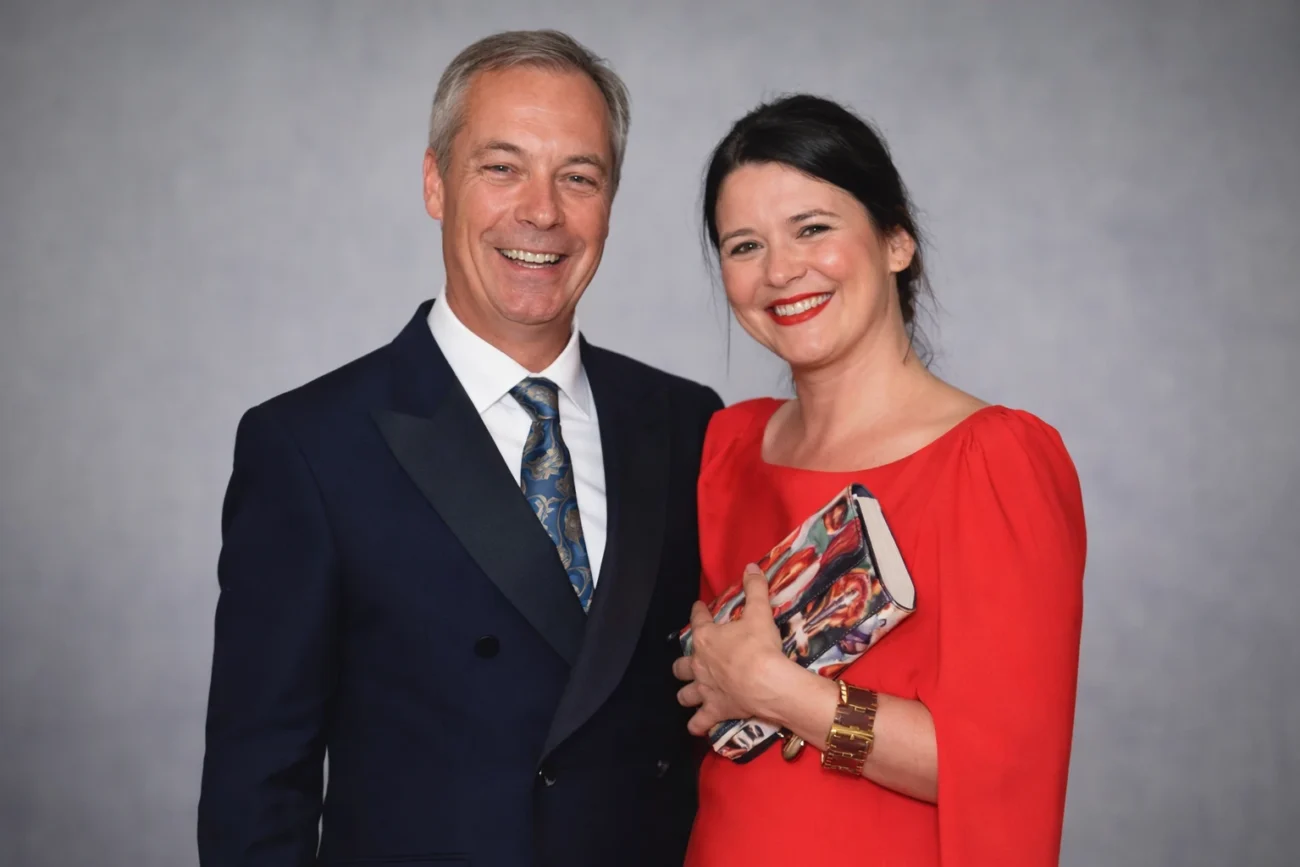
Gráinne Hayes enters the public record almost sideways, her name appearing not through a career in politics or media, but through a moment of crisis in someone else’s life. In November 1985, a young commodities trader named Nigel Farage was seriously injured after being hit by a car. During his recovery, he met a nurse who would later become his wife. That nurse was Hayes. Nearly four decades later, as Farage remains a prominent and often controversial figure in British politics, interest in Hayes has resurfaced—not because she has stepped into the spotlight, but because she never did.
The fascination with Gráinne Hayes says as much about modern curiosity as it does about her own life. Readers want to understand the people who shaped public figures, especially during the formative years before fame. Yet Hayes’s story resists that impulse. What exists is a narrow but verifiable outline: an Irish nurse, a marriage that lasted less than a decade, two sons, and a decision—whether deliberate or simply natural—to remain outside public attention. Everything else requires careful handling, because the gap between documented fact and repeated speculation is wider than many online profiles suggest.
Early Life and Background
Public information about Gráinne Hayes’s early life is limited, and that limitation is important to acknowledge. She is widely described as Irish, and multiple secondary sources identify her as having worked as a nurse in the United Kingdom during the mid-1980s. Beyond that, details such as her exact place of birth, upbringing, or education are not firmly documented in widely cited, authoritative sources.
That absence is not unusual for someone who has never sought public visibility. Nurses working within the British healthcare system in the 1980s would not typically leave a public paper trail unless they later moved into leadership, academia, or media-facing roles. Hayes appears to have followed a more private path, which explains why the early chapters of her life remain largely unrecorded in mainstream archives.
Still, the outline that does exist places her within a specific context. The 1980s were a demanding period for healthcare workers in Britain, with long hours and evolving systems under pressure. If Hayes was practicing as a nurse at that time, she would have been working in an environment that required both technical skill and emotional resilience. That professional backdrop becomes relevant when considering the moment that would bring her into public awareness.
Meeting Nigel Farage
The defining turning point in Gráinne Hayes’s public story begins with Nigel Farage accident in November 1985. Farage, then in his early twenties, was struck by a car and suffered significant injuries. He has spoken publicly about the severity of the incident and the long recovery that followed, describing it as a formative experience that changed his outlook on life.
During his hospitalization, Farage met Hayes, who was part of the medical team involved in his care. The exact details of their early interactions are not recorded in depth, but the broad account is consistent across multiple retellings: a patient and a nurse developed a relationship that continued beyond the hospital setting. Over time, that relationship became more serious.
Here’s where the story gains emotional weight, even within its limited documentation. Recovering from a major accident can create an intense environment, where gratitude, vulnerability, and connection intersect. While it would be speculative to assign precise motivations or dynamics, it is reasonable to understand that the circumstances of their meeting played a role in shaping their bond.
Marriage and Family Life
Gráinne Hayes and Nigel Farage married in 1988, about three years after the accident that brought them together. At that point, Farage was still working in commodities trading and had not yet entered the political arena that would later define his public life. Their marriage therefore belongs to a quieter period, before the scrutiny and polarization that would follow him in later years.
The couple had two sons together, Samuel and Thomas. These names appear in mainstream reporting about Farage’s family and are among the most consistently verified aspects of Hayes’s personal life. As with much else, details about their upbringing, schooling, and day-to-day family life have not been widely publicized, reflecting the family’s overall distance from media exposure during that time.
Family life in the late 1980s and early 1990s would have unfolded against a backdrop of professional demands and changing ambitions. Farage has described his early career as intense and time-consuming, which suggests that the household may have experienced the pressures common to many young families balancing work and parenting. Hayes, as a nurse, would likely have faced her own demanding schedule, adding another layer to that dynamic.
Divorce and Separation
The marriage ended in 1997, after roughly nine years. The reasons for the divorce have not been extensively detailed in public records, and neither Hayes nor Farage has provided a widely cited, comprehensive account of the separation. That silence has left room for speculation, but responsible reporting requires restraint in the absence of clear evidence.
What can be said with confidence is that the separation occurred before Farage’s most visible political ascent. He would go on to remarry in 1999, entering a second marriage that coincided with his growing involvement in UK politics. Hayes, by contrast, stepped away from any connection to public life following the divorce.
The timeline matters because it marks a clean break between Hayes’s life and the period in which Farage became a household name. She did not participate in his political rise, nor did she become part of the public narrative surrounding his later career. That separation has shaped how little is known about her today.
Life After the Public Connection
After her divorce from Farage, Gráinne Hayes appears to have returned fully to private life. There is no widely documented evidence of her pursuing a public career, giving interviews, or engaging with media coverage related to her former husband. This absence is consistent across both mainstream reporting and more detailed biographical sources.
Some online profiles attempt to describe her current lifestyle or personal choices, often portraying her as someone who deliberately chose privacy over public attention. While that interpretation may be plausible, it remains largely unverified. Without direct statements from Hayes or reliable, independent reporting, such claims should be treated as interpretation rather than established fact.
What is clearer is the pattern. Over decades in which Farage’s profile grew—from UKIP leadership to Brexit campaigning and later political roles—Hayes remained outside that orbit. In an age where even distant associations can lead to public exposure, her continued absence from media suggests a consistent preference, or at least a consistent outcome, of privacy.
Nigel Farage’s Rising Profile and Renewed Interest
Nigel Farage’s political career has been marked by visibility and controversy, from his leadership of the UK Independence Party to his central role in the Brexit campaign. More recently, he has remained active in British politics, serving as leader of Reform UK and returning to Parliament as MP for Clacton in 2024. Each new phase of his career tends to renew public curiosity about his past.
That renewed attention often brings names like Gráinne Hayes back into search trends. Readers encountering references to Farage’s early life or family naturally look for more information about the people involved. Hayes becomes part of that search cycle, even though she has not contributed to or shaped the public narrative in recent years.
The pattern highlights a broader dynamic. In modern media, the lives of public figures are rarely confined to their own actions. People connected to them—spouses, former partners, family members—can become subjects of interest regardless of their own intentions. Hayes’s story illustrates both the reach of that interest and the limits of what can be responsibly reported.
Public Image and Misconceptions
Because Gráinne Hayes has not cultivated a public image, the one that exists online is largely constructed by others. Many articles describe her in broad, flattering terms, emphasizing qualities like resilience, discretion, or quiet strength. While these descriptions may be well-meaning, they often lack direct evidence or attribution.
The truth is more straightforward. Hayes is a private individual whose documented public role is limited to her past marriage. Assigning detailed personality traits or motivations without supporting sources risks turning biography into fiction. That is especially important in a digital environment where repetition can make assumptions appear factual.
Another common misconception is that Hayes continues to have a visible connection to Farage’s public life. There is no strong evidence to support that claim. The available record suggests that their lives have been separate since their divorce, with no ongoing public collaboration or shared platform.
Financial Status and Net Worth
There is no reliable, publicly verified estimate of Gráinne Hayes’s net worth. Unlike public figures who disclose financial interests or whose earnings are tied to visible careers, Hayes’s financial situation has not been the subject of credible reporting. Any figures that appear online are typically speculative and should be treated with caution.
Her professional background as a nurse provides some context, but it does not allow for precise financial conclusions. Nursing salaries in the United Kingdom vary widely depending on experience, specialization, and seniority. Without confirmed details about her career trajectory after the 1990s, it is not possible to construct an accurate financial profile.
This uncertainty reinforces a broader point about responsible biography. Not every subject lends itself to detailed financial analysis, and forcing that framework onto a private individual can lead to misleading or unsupported claims.
Where Gráinne Hayes Is Now
The question of where Gráinne Hayes is now remains one of the most common—and least answerable—parts of her story. There is no widely accepted, well-sourced account of her current residence, profession, or daily life. What can be said is that she has not re-entered public discourse in any significant way.
That absence may be frustrating for readers seeking closure or a complete narrative, but it is also a reflection of personal boundaries. Many individuals connected to public figures choose to maintain distance from media attention, and Hayes appears to fall into that category.
In practical terms, this means that the most accurate answer is also the simplest. Gráinne Hayes lives outside the public eye, and there is no credible evidence suggesting otherwise.
Frequently Asked Questions
Who is Gráinne Hayes?
Gráinne Hayes is an Irish former nurse best known as the first wife of British politician Nigel Farage. She married him in 1988 after meeting him during his recovery from a serious accident, and they divorced in 1997. Her public profile is otherwise minimal.
How did Gráinne Hayes meet Nigel Farage?
They met in 1985 when Farage was hospitalized after being hit by a car. Hayes was part of the medical team involved in his care, and their relationship developed during his recovery period.
Did Gráinne Hayes have children with Nigel Farage?
Yes, they had two sons, Samuel and Thomas. These details are confirmed through mainstream reporting about Farage’s family.
Why is there so little information about her?
Hayes has remained a private individual and has not participated in media coverage or public life. As a result, there are few primary sources or official records detailing her biography.
What is Gráinne Hayes’s net worth?
There is no credible public estimate of her net worth. Any figures found online are speculative and not supported by reliable evidence.
Is Gráinne Hayes still connected to Nigel Farage?
There is no evidence of an ongoing public connection between them. Their marriage ended in 1997, and their lives appear to have remained separate since then.
Conclusion
Gráinne Hayes’s story stands apart from the typical biography. It is defined not by public achievements or media presence, but by its boundaries. She appears briefly in the documented life of a man who would later become a major political figure, and then she steps out of view.
That limited visibility can feel incomplete, especially in an era where information is expected to be constant and detailed. But there is clarity in what is known. Hayes was part of Nigel Farage’s early life, shared a marriage and family with him, and then moved on without entering the public arena that surrounded his later career.
What remains is a reminder that not every life connected to public power becomes a public story. Some remain private by circumstance, by choice, or by both. In Gráinne Hayes’s case, that privacy is not a gap to be filled. It is the most consistent and defining feature of the record itself.
